New York State (NYS) has experienced a succession of crises over the past half century—so much so that one might reasonably suggest that crisis governance has become a “normal” feature of our contemporary state and local politics. This website is devoted to exploring New York State politics and governance through the lens of crisis as an umbrella term for the range of challenges that the state has faced, with an emphasis on the economic, political, and leadership challenges of governing in the Empire State since the 1970s. In doing so, we seek to contribute to the deeper understanding of New York’s unique history and politics in a way that we believe will be of interest to all state and local politics scholars. Crisis governance studies have proliferated, but there are few treatments focusing on state and substate crisis management generally or outside of the context of natural disaster or emergency disaster response. By applying a crisis lens to the study of NYS, we demonstrate the challenges and pitfalls of the ubiquitous language and framing of crises and the ongoing academic debate over what constitutes a crisis.
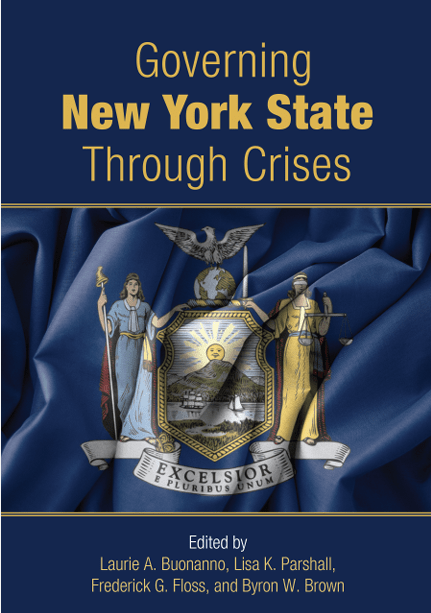
This website is a companion resource to Governing New York State Through Crises, edited by Laurie Buonanno, Lisa Parshall, Fred Floss, and Byron Brown (June 2026, SUNY Press).
Download book flyer to receive discount on paperback (publishing December 2026)
Book Description
Explains how New York’s institutions and policymakers have governed the state through a series of contemporary crises.
This volume takes a fresh approach to the study of New York State politics and government through an examination of governance in times of crises. Contributors address several questions including: How have state and local governments responded to this succession of crises? What has been the role of political parties and party competition in tackling these crises? How have governing institutions adapted to these crises? Which factors have contributed to resolution of crises and which have prevented the resolution of others? The chapters cover the major institutions of state government, the challenges and pressures for New York State municipalities, and several contemporary crises, including housing, climate change, migration, an aging and declining population, and deindustrialization. By using the lens of crisis, this book provides both a historical and future-looking discussion of governance of the Empire State.
“This impressive volume provides an in-depth explanation of the politics of crisis management at the state and local levels in New York State. In addition, using crisis governance as the lens, it updates and deepens our understanding of New York’s government as a whole.” — Daniel L. Feldman, coauthor of The Art of the Watchdog: Fighting Fraud, Waste, Abuse, and Corruption in Government
Table of Contents
Introduction: Crisis Governing in New York State
Part I. Institutions, Budgetary Politics, and Crises
1. The Executive and Crises
Laurie A. Buonanno and Lisa K. Parshall
2. The New York State Legislature
William C. Conrad III, Laurie A. Buonanno, and Frederick G. Floss
3. New York Courts in Crisis
Anonymous
4. Budgeting and Crisis
Frederick G. Floss, Laurie A. Buonanno, and Lisa K. Parshall
Part II. Localities and Crises in New York State
5. Economic Divergence: Crises and the Upstate-Downstate Divide
Carolyn M. Dudek
6. Cities Under Stress
Lisa K. Parshall
7. Buffalo: The “Comeback City” on Lake Erie
Byron W. Brown
8. Budgetary and Reorganization Pressures on Local Government in New York
Lisa K. Parshall
9. Schools in Crisis: Providing a Sound Basic Education
Casey Jakubowski, Lisa K. Parshall, Frederick G. Floss, and Laurie A. Buonanno
Part III. Contemporary Policies and Crises
10. New York’s Climate Change Policy
Laurie A. Buonanno, Frederick G. Floss, and Gregory P. Rabb
11. The Affordable and Adequate Housing Crisis in New York State
Lisa K. Parshall
12. Counties Under Pressure: The Death of County Nursing Homes
Laurie A. Buonanno, Frank Ciaccia, and Lisa K. Parshall
13. New York’s Approach to Migration
Laurie A. Buonanno, Todd O’Bryan, and Lisa K. Parshall
Conclusion Learning from Crises in the Empire State
Byron W. Brown, Laurie A. Buonanno, Frederick G. Floss, and Lisa K. Parshall
The Academic Team
This website is curated by college professors who teach New York State government, politics, and budgeting.
Byron W. Brown is Professor of Practice in Public Administration at SUNY Buffalo State University and President and CEO of Western Regional Off-Track Betting Corporation. He was a member of the Buffalo Common Council and a New York State Senator prior to serving as a five-term mayor of the City of Buffalo (2006-2024).
Laurie A. Buonanno is Professor of Public Administration at SUNY Buffalo State University, Director of the Institute for European Union Studies at SUNY, and a European Union Erasmus+ Jean Monnet Chair (2025-2028). Her research centers on policymaking in federal systems. Her books include Policies and Policymaking in the European Union (Bloomsbury) and The New and Changing Transatlanticism: Politics & Policy Perspectives (Routledge).
Frederick G. Floss is Professor of Economics & Public Administration at SUNY Buffalo State University. He is Secretary of the Buffalo Fiscal Stability Authority, a member of the Kenmore-Tonawanda School Board, and previously served as executive director of the Fiscal Policy Institute and statewide president for the United University Professions.
Lisa K. Parshall is Distinguished Professor of Political Science at Daemen University, Amherst, New York and a policy fellow at the Nelson A. Rockefeller Institute of Government. Her books include In Local Hands: Village Government Incorporation and Dissolution in New York State (SUNY Press) and Directing the Whirlwind: Deconstruction, Distrust, and the Future of American Democracy (Peter Lang).


You must be logged in to post a comment.