posted 22 May 2026, updated 26 June 2026
The NYS Legislature and the Governor have reached an agreement on a sweeping package of bills limiting cooperation with federal immigration enforcement agencies as part of the 2026-2027 FY budget negotiations. The NYS Assembly and Senate passed these laws on 21 May 2026. Governor Hochul signed them on May 29. The new legislation prohibits cooperative agreements between local law enforcement agencies and ICE. These are known as 287(g) MOAs.
“I wish you would just do your job”: NYS Says Immigration Enforcement is a Federal Responsibility
Kathy Hochul responded to Republican congressional needling: “You’re putting a federal problem in our laps. And you know what? It gets old after a while. I wish you would just do your job.” She has a point. The foundation of immigration law is the Immigration and Nationality Act (INA) of 1952 aka the McCarran-Walter Act, which has been amended several times. Enforcement has been particularly emphasized in several of the acts amending the INA, particularly the Immigration Reform Act of 1986 (IRCA) (the first large-scale amnesty program in the US and expanded border enforcement), the Illegal Immigration Reform and Immigrant Responsibility Act of 1996 (IIRAIRA), the USA PATRIOT Act of 2001, Homeland Security Act of 2002, and the REAL ID Act of 2005. These acts established criminal sanctions for “certain criminal conduct that undermines immigration rules” (CRS Report and Immigration Offenses). The IRCA and the IIRAIRA accelerated the criminalization of immigration, with the IIRAIRA marking a shift to strict enforcement. There are three specific categories of immigration-related criminal offenses:
- Improper Entry & Illegal Reentry (especially after previous deportation)
- Bringing in, Harboring, Transporting, or Inducing/Encouraging Aliens to Come to the US
- Immigration-Related Fraud- this third category covers several areas: visa fraud & false statements; marriage fraud; false claim of US citizenship; passport fraud; procurement of citizenship or naturalization unlawfully.
There are also other immigration related criminal offenses in federal statutes such as high-speed flight from an immigration checkpoint; importation, holding, or keeping of an alien for prostitution or “any other immoral purpose”; failure to depart after a final order of removal; willful failure by an alien to apply for registration and be fingerprinted; failure to notify of a change of address.
Yet many common violations of immigration law are civil in nature such as overstaying a visa (accounts for 45% of unauthorized migrants in the US), unauthorized employment, violation of nonimmigrant status (e.g. a tourist working while on a B-1 or B-2 visa), failure to depart after a removal order, failure to register change of address, document violations (e.g. failing to carry registration documents), public charge violations, misrepresentation or fraud in immigration applications (see above for fraud that can trigger a criminal charge), employer paperwork violations (e.g. hiring unauthorized workers, failure to retain I-9 records), unlawful presence accrual, SEVIS/student reporting violations (international students failing to maintain required reporting or enrollment obligations). (Sometimes actions can be both criminal and civil violation of the INA.)
Congress had not fully grappled with the lack of federal law enforcement personnel when it began to emphasize (especially) interior enforcement. ICE has access to about 20,000 federal employees and contractors for enforcement actions in the US interior. There are 22,000 US Border Patrol officers and 33,000 Customs and Border Protection officers at the nations’ 328 official ports of entry. There are 788,000 state and local government sworn officers. (Despite recent personnel increases to ICE, these numbers pale in comparison to local law enforcement capability.)
Section 133 of the IIRAIRA established the 287(g) program to gain access to state and local resources. Section 287(g) “deputizes” local and state law officers to carry out immigration work by negotiating memorandums of agreement (MOAs) with local and state law enforcement agencies. These 287(g) MOAs are voluntary. Figure 1 maps the extent of 287(g) participation.
Figure 1: 287(g) Participating Agencies
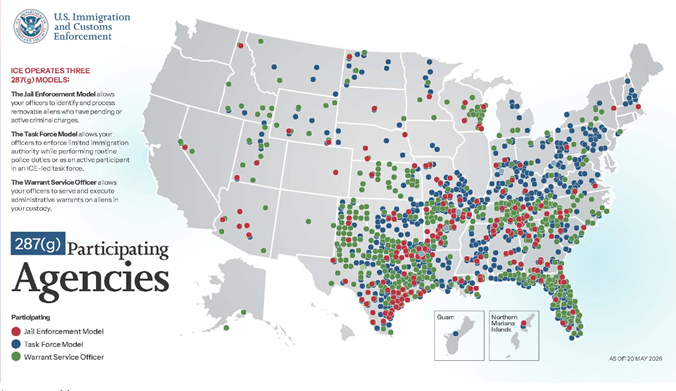
Source: https://www.ice.gov/identify-and-arrest/287g
Presidential executive actions have also been aimed at gaining local cooperation. President George W. Bush established the Secure Communities Program (2008), which President Obama replaced in 2015 with the Priority Enforcement Program. Complaints had been rolling in about the Secure Communities Program – racial profiling, damage suits for wrongful detention, personnel costs, concern migrants would no longer cooperate with local police, and ICE nabbing immigrants on minor offenses and immigration violations rather than for violent crimes. In 2011, NYC became the first jurisdiction to limit cooperation with federal detainers (requests for immigration authorities to hold an individual for two more days until federal authorities could arrive to pick them up). Other communities followed suit. Some other communities, such as the City of Buffalo under Mayor Byron Brown, did not issue EOs or legislate sanctuary policies, but quietly instructed the police department not to cooperate without a judicial warrant. The disagreement is not limited to that of costs and public safety. The standoff involves states’ rights and anticommandeering principles (the latter being based on SCOTUS rulings barring the federal government from commandeering state and local employees without their consent).
President Trump, in his first administration, revived Secure Communities and ramped up efforts to sign 287(g) MOAs. Several blue states responded with legislation to prohibit local law enforcement agencies to sign up for the program: California (2017), Connecticut (2019), Delaware (2025), Illinois (2019), New Jersey (2019), Oregon (2019), and Washington (2019).
New York stood out as a blue state exception.
287(g) MOAs in New York State
Several local police departments in NYS have signed 287(g) MOAs. Table 1 illustrates that 287 (g) MOAs have accelerated dramatically in the first year of the second Trump administration.
Table 1: 287(g) MOAs in New York State (as of May 2026)[1]
| County | Warrant service officer | Task force model | Jail enforcement model |
| Allegany Village Police Department | 1/7/2026 | ||
| Broome County Sheriff’s Office | 3/10/2025 | ||
| Camden Police Department | 7/2/2025 | ||
| Cattaraugus County Sheriff’s Office | 11/19/2025 | ||
| Madison County Sheriff’s Office | 3/19/2016 | ||
| Mohawk Village Police Department | 3/19/2025 | ||
| Nassau County Police Department | 3/10/2025 | ||
| Nassau County Sheriff’s Office | 2/28/2025 | ||
| Niagara County Sheriff’s Office | 5/7/2025 | 5/8/2025 | |
| Otsego County Sheriff’s Office | 10/17/2025 | ||
| Renssalaer County Sheriff’s Office | 6/10/2020 | ||
| Steuben County Sheriff’s Office | 7/29/2025 | 7/23/2025 |
Source: Delegation of Immigration Authority Section 287(g) Immigration and Nationality Act
Background to NYS Cooperation with Federal Immigration Enforcement Authorities: Balancing Progressives and Moderates
While progressives have long championed the New York for All Act (S.2235A/A.3506A) (lead sponsors – NYS Senator Andrew Gounardes and NYS Assemblymember Karines Reyes). This act proposed banning state and local officers from using state or local resources for civil immigration enforcement, prohibiting federal immigration enforcement officials from entering non-public areas of state and local property, and prohibiting sharing of sensitive information with ICE without a judicial warrant. Both Governors Cuomo and Hochul had resisted a legislative solution to cooperation with federal authorities. Instead, Governor Cuomo signed EO No. 170 (September 2017), which Governor Hochul renewed, restricting state employees (including the state police) from disclosing information to federal immigration authorities for civil immigration enforcement purposes and prohibiting them from inquiring about individuals’ immigrant status unless required by law or necessary for benefit eligibility. Cuomo and Hochul opposed New York for All’s call for the prohibition of 287 (g) MOAs for several reasons. First, Donald Trump’s 2016 presidential unexpected win over Hillary Clinton, the close margin of Hochul’s 2022 gubernatorial race against the then Long Island congressperson Lee Zeldin (who currently heads the Environmental Protection Agency), and the 2022 midterm losses of NYS congressional seats to Republicans together were interpreted as the voters’ appetite for tougher immigration enforcement/tough on crime sentiment. Second, NYS Democratic Party leaders continuously struggle to balance the moderate and progressive wings of their party. Third, Albany is deferential to home rule, particularly when it is politically expedient. Less than year ago at the 12 June 2025 House Oversight Committee “with Sanctuary Governors,” Hochul reiterated home rule as the reason that Albany does not interfere with local sanctuary policies but also permits local law enforcement agencies to sign 287 (g) MOAs.
Nevertheless, the NYS Democratic leaders’ strategy of bridging their party’s liberal and conservative divide was upended in early 2026 by aggressive federal anti–immigration enforcement in Minneapolis (federal immigration officers’ killings of two American citizens, Renee Good and Alex Pretti), and the death of refugee Nurul Amin Shah Alam in Buffalo after being released by the Erie County Sheriff’s department into Customs and Border Protection (CBP) custody. After determining that Alam was not in violation of immigration law, CPB officers dropped him off in front of a closed Tim Hortons’ coffee shop in the city’s Black Rock neighborhood on 19 February 2026 dressed in “holding center attire and jailhouse slippers.” Alam was blind and did not speak English. CPB had failed to notify Alam’s family that he had been released from custody. Alam was found dead several days later.
Governor Hochul introduced the Local Cops, Local Crimes Act, which proposed a prohibition of 287 (g) MOAs (along with other measures) in response to these tragic events.
A crisis of the federal government’s own making opened a window for NYS Democratic leaders to abandon their previous compromise position and follow the path of uncooperative federalism forged by other blue states during the first Trump administration.
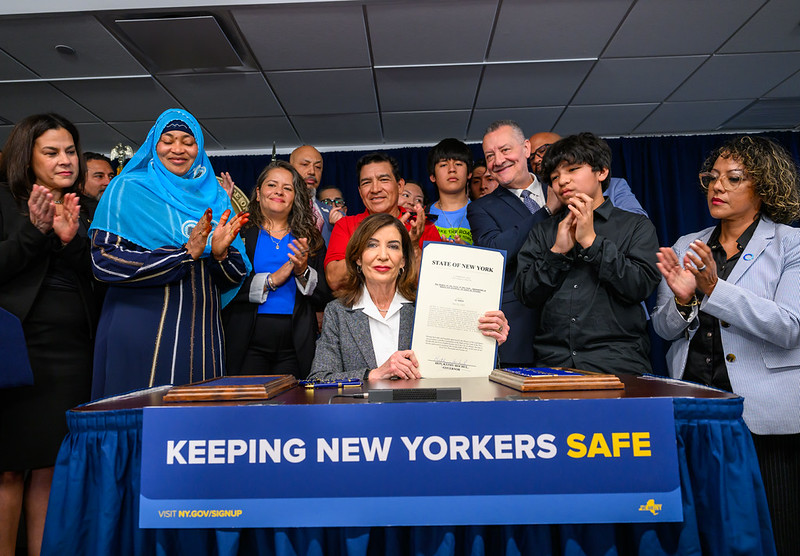
Local Crimes, Local Cops Act is in the Public Protection and General Government Budget Bill: What the New Legislation Does
1. Prohibits 287(g) MOAs.
2. Allows private places (deemed “sensitive”) to deny access to ICE.
3. Prohibits all law enforcement officers from wearing masks except for safety needs. Extending the mask prohibition to all law enforcement is an attempt to avoid courts striking down NYS’s law as discriminatory. A federal court struck down California’s law that had banned federal law enforcement from wearing masks.
4. Prohibits state and local governments from dedicating resources to immigration enforcement (such as providing traffic control for ICE while engaging in raids and detaining immigrants on behalf of the federal government).
5. Establishes an Office of Immigrant Trust, which will be located in the Office of the NYS Attorney General, with enforcement power.
6. New Yorkers can sue federal immigration authorities over alleged civil rights violations.
7. Bars most local and state public employees from cooperating with federal immigration enforcement authorities unless they present a judicial warrant.
Did New York For All Advocates Get Everything They Wanted?
No. As long as it does not appear to be a pattern that mimics formal cooperation, the new law permits informal cooperation between local police and federal immigration enforcement authorities, while banning municipal and state employees from doing so. The New York For All legislation had proposed banning both informal and formal police cooperation except when federal immigration officers presented judicial warrants. This is an important loss for them because advocate argue that much of the cooperation between local police and ICE/CPB is informal.
Sponsors pledge to continue to fight for all provisions of New York for All Act to be passed before the end of the legislative session. With the budget almost two months overdue, just two weeks left in the legislative session, the need for many legislators’ to get out on the hustings (NYS’s primary election is 23 June), and the national Democrat Party’s expectation that the legislature pass constitutional amendments proposing redistricting rules so that they can appear on the November 2027 ballot, there is little appetite among the legislative leadership to revisit this legislation in the current session.
What’s Next?
President Trump’s border czar (and NYS native) Tom Homan had threatened an ICE surge into New York if the legislature passed this package of laws. Bruce Blakeman, Nassau County Executive and the GOP gubernatorial candidate – whose county sheriff and police departments signed 287(g) MOAs in 2025 (and includes space in Nassau County jails for civil immigration enforcement) – responded “We will take them to court.” If a local law enforcement agency refuses to end their 287 (g) MOAs, legal compliance will be in the hands of the NYS Attorney General’s new Office of Immigrant Trust.
Legal Challenges
Anticipating federal challenges, Governor Hochul and Attorney General James filed suit against the Trump administration on 22 June in the Federal District Court in Albany. Their suit is based on “a sovereign right under the Tenth Amendment to enact laws that protect public safety, promote transparency, and regulate conduct within its borders.” The Trump administration filed a concurrent legal challenge on 23 June to the new ban on law enforcement officers wearing masks, the identification requirement, and to the State’s prohibition of local law enforcement agencies to have formal cooperation agreements (namely, 297 (g) MOAs). The federal lawsuit was filed in the Federal District Court in Buffalo.
On 9 February, a federal judge struck down a California law prohibiting federal law enforcement agents from wearing masks, but upheld another law requiring federal law enforcement agents to display identification. Judge Christina A. Snyder, U.S. District Court of Los Angeles issued a preliminary injunction blocking the mask law on grounds that it was discriminatory because state law enforcement officials were exempted from the law. But in April the 9th U.S. Circuit Court of Appeals unanimously agreed that the identification requirement violates the U.S. Constitution’s Supremacy Clause even though California’s identification law applied to both local and federal agents. New York attempted to craft its new policy to avoid the fate of California’s laws. These rulings are cited in the Trump administration’s lawsuit filed against New York.
Governor Hochul’s response to the federal lawsuit? “These laws reflect New York’s values, and we’re not going to let anyone bully us into abandoning them.”
[1] Jail Enforcement Model: permits local police officers to identify and process removable aliens in jail or detention facility who have pending or active criminal charges while they are in police custody. Task Force Model: allows officers to enforce limited immigration authority while performing routine police duties, such as identifying and alien at a DUI checkpoint and sharing information directly with ICE. Warrant Service Officer program: ICE trains, certifies, and authorizes officers to serve and executive administrative warrants on aliens currently in the agency’s custody. See https://www.ice.gov/identify-and-arrest/287g.
For more about this topic, see Essay: New York State’s Migration Crisis and Governing New Yok State Through Crises, Chapter 13.


You must be logged in to post a comment.