In Governing New York State Through Crisis, we addressed the fiscal stress facing the state’s local governments. Among the municipalities most in need are cities, particularly mid-sized, Upstate cities suffering from declining population, aging infrastructure, and deindustrialization.
With its focus on affordability, the NYS Enacted Budget Financial Plan for FY 2027, provides additional assistance to financially distressed municipalities. Base funding through the Aid and Incentives to Municipalities (AIM), the State’s primary municipal assistance program, meanwhile, remained flat (at $715 million).
Where the Additional Assistance was Directed
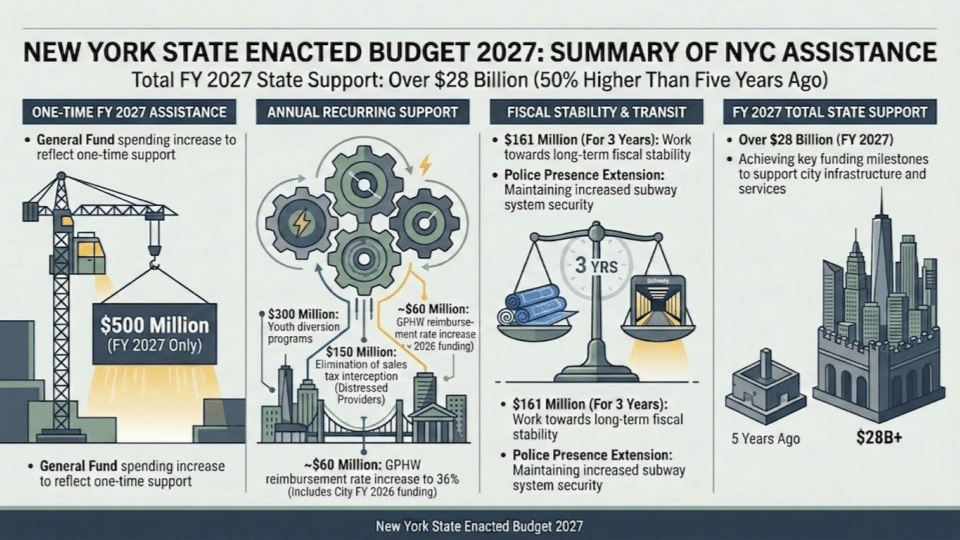
A significant portion of this additional aid is targeted to New York City. In addition to an injection of one-time assistance totaling $500 million and $161 million for 3 years is included for NYC as it works towards long-term fiscal stability, the state is providing additional support for youth diversion programs ($300 million), distressed health care providers ($150 million), and an extension of support for policing of the subways. Moreover, the budget introduced for New York City a pied-à-terre tax program, which places a surcharge on high value second homes and investor-owned apartments worth $5 million and up that is anticipated to generate another $500 million in tax revenue annually. In total, the various programmatic and local assistance aid “increases raise the total State support provided to NYC to over $28 billion in FY 2027 – 50 percent higher than the levels five years ago” (2027 Fiscal Plan, 24).
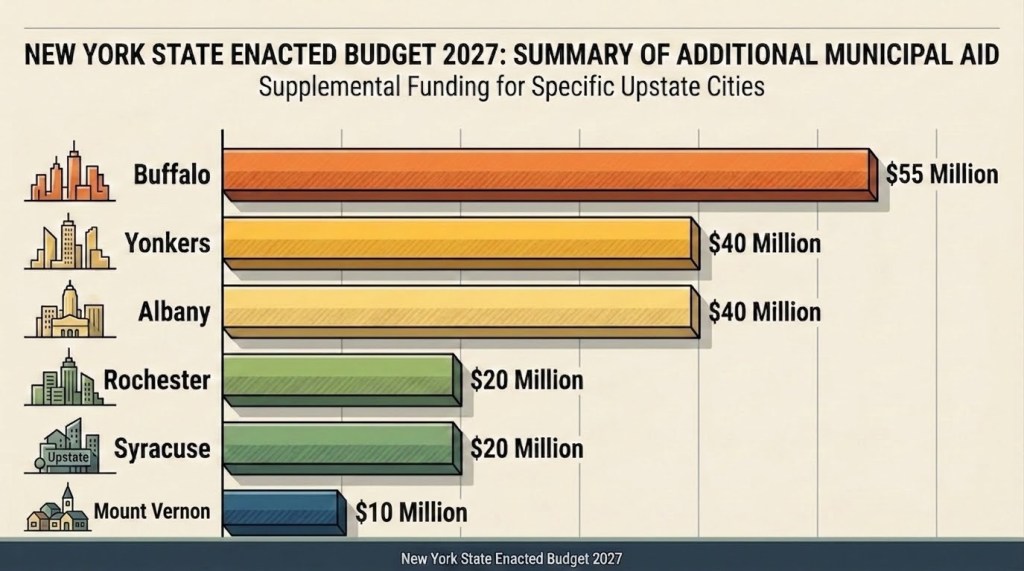
Outside of NYC, other municipalities received additional, targeted State assistance through FY 2029, including the cities of Albany, Buffalo, Rochester, Syracuse, and Yonkers. In addition to the funding for distressed cities, the largest amount of which ($40 million) went to Yonkers. Albany and Buffalo received additional funding through Capital City Aid and Temporary Municipal Assistance, raising their total in additional funding to $40 and $55 million, respectively.
The Controversy over Targeted State Assistance
On the one hand, the additional funding from NYS is necessary to assist municipalities that are struggling with fiscal stress, have high property-tax burdens, and are constrained by the NYS Tax Cap. As extensively discussed in Governing New York State Through Crises, the fiscal problems of the cities have a far-reaching impact. The state ignores their dilemma at its own peril. The lobbying by upstate mayors ahead of the budget–an event known as “Tin Cup” day–—revealed a level of urgency and fear of having to drastically cut city services. In Albany, for example, the city is facing a budget deficit of over $20 million in each of the next two years and is staring down severe service cuts, spending freezes, and layoffs. In Buffalo, a severe structural deficit (projected by the Office of the State Comptroller at over $100 million) has resulted in a proposed 25% increase in property taxes—negotiated down in the budgeting process to a 19% increase. The additional money is thus a life-line for budget-strapped cities facing growing expenditure expectations and limited revenue sources in a period of limited and uncertain federal support.
On the other hand, there are significant questions as to whether the precedent for additional state-provided support is sustainable given the assisted cities’ structural deficit problems and the headwinds upstate cities face. The assistance, in other words, is a temporary bandaid for a recurring problem. The governor’s Republican critics and fiscal watchdog organizations have pointed out that the additional state support comes with no restrictions or requirement for municipalities to engage in long-range planning, although many are, and under the administration of newly elected mayors who are grappling with problems and conditions decades in the making.
The additional spending has helped to swell New York State’s budget to a record $277 billion, ten percent higher than last year, and to open up a state budgeting gap of more than $6 billion dollars—at a time when federal funding has become increasingly unreliable.
The dilemma for state leaders is obvious: the residents of the State’s major cities are in need of critical assistance at the same time that the State is grappling with a dizzying array of state-wide problems of significant magnitude. Adding to all of this is the downward pressure of declining federal aid, and targeted pressure from the federal government, in the form of funding cuts and grant cancellations. The questions thus become, in mitigating the immediate crisis of these struggling cities, are we adding to the larger ongoing fiscal crisis of the state? And, how are multiple crises to be managed given the fiscal stress faced by New York State and its localities?
 Governing New York State Through Crises
You must be logged in to post a comment.